


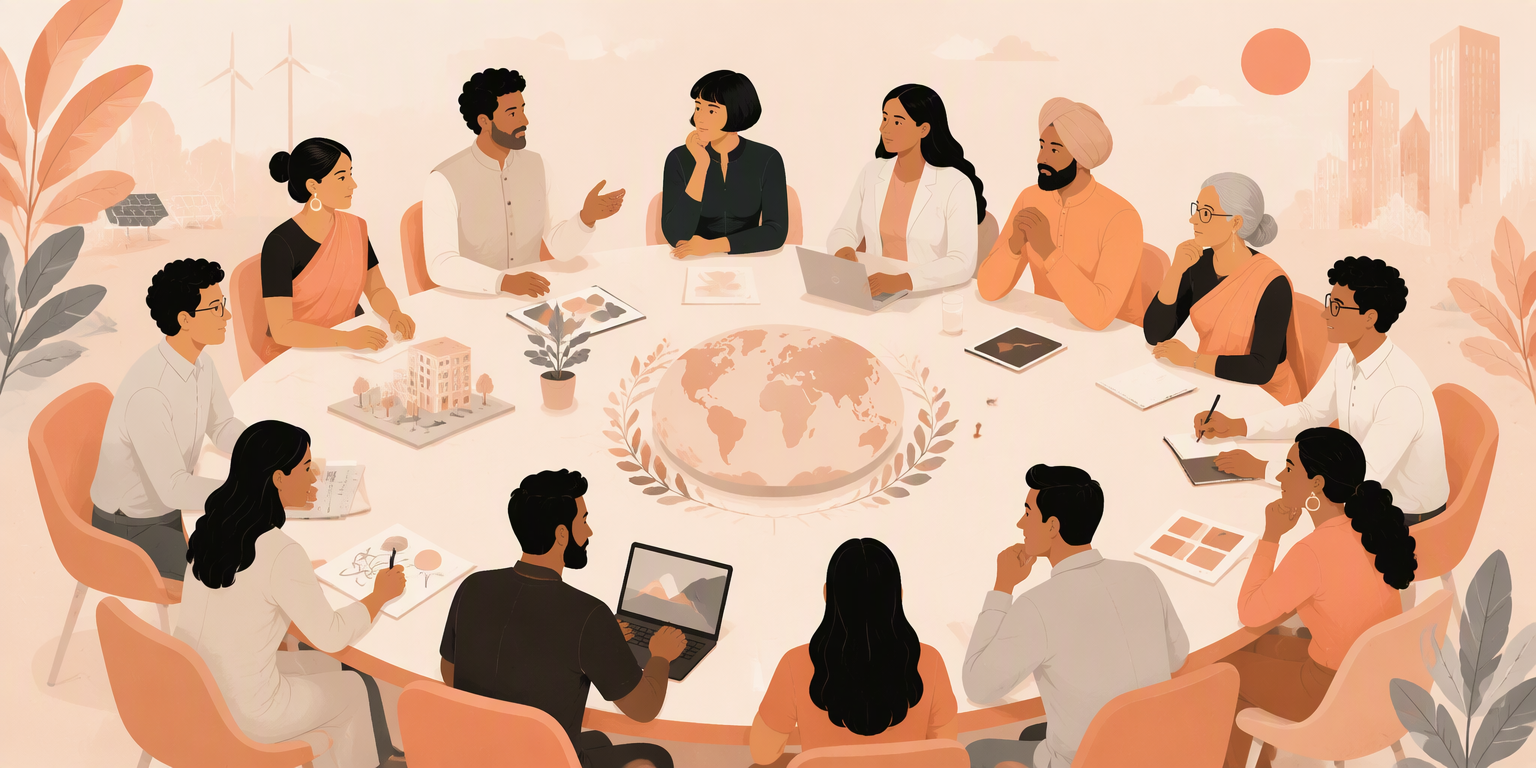
London Climate Action Week brought together an unusually diverse group of people - researchers, architects, lawyers, philanthropists, artists, technologists, designers and public health practitioners. While their disciplines differed, the conversations revealed an increasingly shared understanding: climate change is no longer a challenge that can be addressed within sectoral boundaries.
That convergence was perhaps the most significant observation I took away from the week.
For a long time, climate action was largely driven by environmental scientists, policymakers and advocates. Today, the conversation is much broader. Every sector is beginning to ask the same question: what role can we play in building a more climate-resilient future?
What struck me was not simply the diversity of voices, but the fact that they were often grappling with the same underlying challenge from different vantage points.
An architect spoke about designing buildings that reduce heat exposure. A lawyer reflected on climate accountability. Philanthropists discussed new approaches to financing innovation. Researchers shared emerging evidence, while designers and artists explored how culture and behaviour influence climate action.
Individually, these conversations addressed different aspects of the problem.
Collectively, they illustrated something much bigger.
Climate change is exposing just how interconnected our systems really are.
Take extreme heat as an example. While it is often discussed as a health issue, the factors that determine how people experience heat extend far beyond healthcare. They include housing, urban design, livelihoods, transport, working conditions, social protection and governance. Strengthening resilience therefore requires stronger connections across systems.
One of the most encouraging aspects of the week was the willingness of people from very different disciplines to learn from one another. Researchers were speaking with designers. Funders were engaging with practitioners. Technology innovators were listening to community organisations. There was a growing recognition that expertise alone is not enough; collaboration is becoming just as critical.
In many ways, this reflects something public health has understood for decades. Health has always been shaped by the conditions in which people are born, live, work and age. Climate change does not fundamentally alter that understanding; it amplifies it. It makes visible the relationships between systems that have always existed but were often addressed in isolation.
What felt different in London was seeing this systems perspective emerge as common ground across sectors. Whether the discussion was about infrastructure, finance, technology or policy, there was an implicit recognition that resilient communities cannot be built through isolated interventions.
For organisations like Swasti, this reinforces the importance of systems leadership.
Climate resilience will depend on our ability to convene diverse actors, foster collaboration and connect evidence, policy, innovation and lived experience. No single institution, discipline or solution can address the complexity of climate change. Progress will depend on how effectively we enable different parts of the system to work towards shared outcomes.
Perhaps that is the real shift underway. Different sectors are beginning to recognise that they have always been part of the climate solution.
That, more than anything else, gives me confidence that we are moving towards a more integrated and ultimately more effective response to one of the defining public health challenges of our time.
Check out our climatexhealth work here: https://swasti.org/climate-x-health
